Tuesday, 9 April 2019

The Bear went over the Mountain

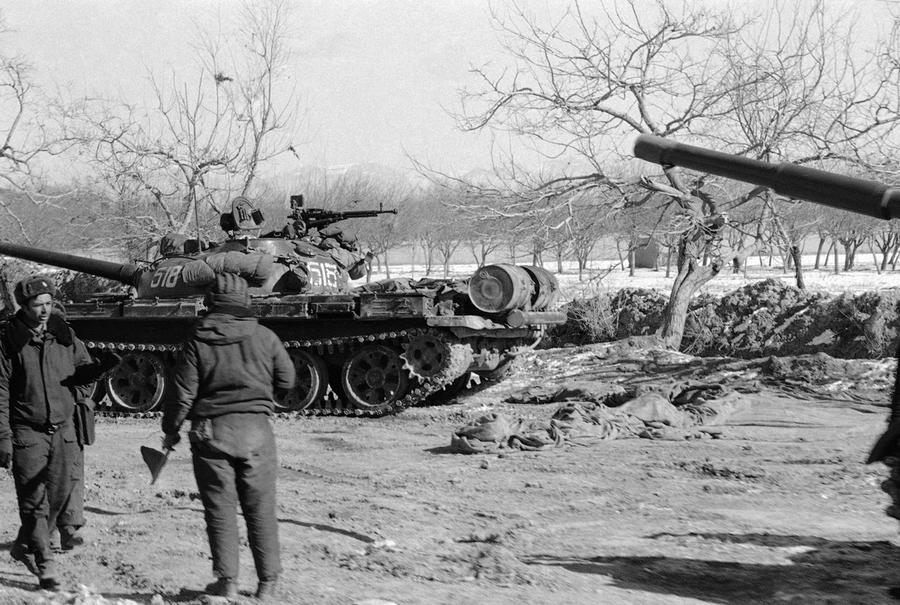
Soviet soldiers direct tank traffic outside Kabul on January 7, 1980.
Soviet Combat Tactics is an original Soviet publication (translated into English, of course!), that contains a compilation of lessons learned on conflicts involving Russian tactics, civil war, guerrilla forces, and rough terrain during the Soviet Afghan War. It contains lessons to help small unit leaders understand security, deception, patrols, discipline, caution, vigilance, and the ability to seize the initiative in unpredictable enemy actions and ambushes. "To capture the lessons their tactical leaders learned in Afghanistan and to explain the change in tactics that followed, the Frunze Military Academy compiled this book for their command and general staff combat arms officers. The lessons are valuable not just for Russian officers, but for the tactical training of platoon, company and battalion leaders of any nation likely to engage in conflicts involving civil war, guerrilla forces and rough terrain. This is a book dealing with the starkest features of the unforgiving landscape of tactical combat: casualties and death, adaptation, and survival."

Sunday, 10 March 2019

A Long Way: Russian Military Reform – Part 1/3

A soldier of  76th Guards Air Assault Division of Russia’s Airborne Forces (VDV)
by Patrick Truffer (originally published in German). He has been working in the Swiss Armed Forces for more than 15 years, holds a bachelor’s degree in public affairs from the Swiss Federal Institute of Technology in Zürich (ETH Zurich), and a master’s degree in international relations from the Free University of Berlin. - From the introduction of the original page @offiziere. Please follow here to access the article in English.

Monday, 4 March 2019

Attack of a battalion sized Task Force

to seize key terrain airfield Langenlebarn and Danube-bridge Tulin South after airborne operation with main focus on the capabilities Deployment and Sustainability” researches the following topic: Which kind of mobility needs a battalion sized airborne unit of the Austrian Armed Forces to seize key terrain with a preliminary attack after airborne operations and to hold the area for more than 48 hours until follow-on troops will relief in place? The author’s (Oberstleutnant Bernhard Schulyok) research interest was based on the challenge to analyse the structure of 25 Infantry Battalion as only airborne unit of the Austrian Armed Forces, concerning the capability to carry out an airborne assault and to describe needed further development.